Gamification in Fitness Apps & Product-Market Fit | Dewais
Posted Feb 16, 2026 15 min read
Learn how smarter MVP validation in sports tech reduces market risk and tests product-market alignment before scaling investment.
Gamifying the Sports Industry: What BeFirst Teaches Startups About Product-Market Fit
In Sports Tech, Product-Market Fit Is the Real Risk
Engineering is no longer the barrier to entry in today’s sports tech landscape. Market alignment is the challenge to overcome.
Accessing the right technology and resources for a new build is easy. Cloud-native infrastructure is accessible. Mobile frameworks like React Native accelerate cross-platform builds, and AI tooling drastically reduces development time. MVP validation can happen in months (or sometimes weeks).
The technical path to launch has never been more achievable.
And yet, most fitness and sports technology startups fail because they built something the market didn’t fully need.
Why Product-Market Fit Still Fails Startups
Product-market fit remains the single most misunderstood and underestimated challenge. CTOs know the architecture, and founders know the vision. However, what neither can assume is whether the product will meaningfully change user behavior in a way that sustains engagement.
This is especially true for gamification in fitness apps — a space already crowded with trackers, wearables, leaderboards, and social integrations. In this environment, speed to market creates opportunity, but sustained retention creates your competitive advantage.
A Case Study in Smarter Validation: BeFirst
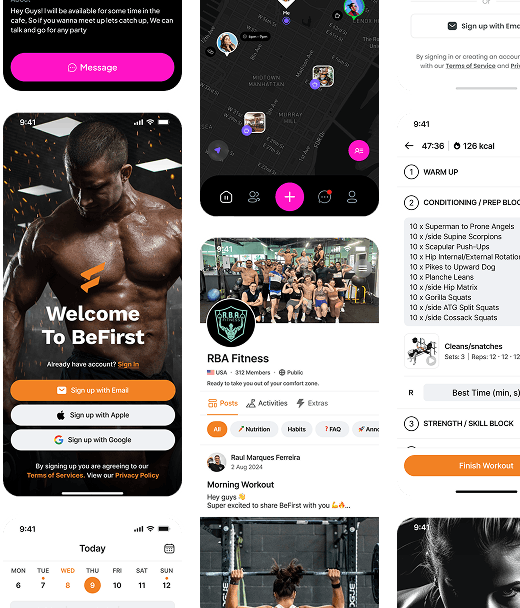
The development of BeFirst, a community-driven fitness platform inspired by models like Strava and Duolingo, offers a useful lens into the market fit challenge. What began as an ambitious attempt to gamify daily training for CrossFit, gym, and calisthenics athletes evolved into something more instructive: a case study in how MVP validation, behavioral design, and iterative refinement create real product-market fit in sports tech.
The article that follows is a strategic examination of how smarter validation reduces market risk and tests product-market alignment before scaling investment.
The Hypothesis: “Strava for CrossFit”
Every product begins with a hypothesis. The risk in sports tech is untested assumptions about behavior. To understand how smarter validation reduces market risk, the first step is to understand the core concept inside and out.
For BeFirst, the core hypothesis was compelling: CrossFit and calisthenics communities are competitive, identity-driven, and socially motivated. If competition fuels these environments, then a structured, gamified fitness platform should increase consistency and deepen engagement.
From a market opportunity standpoint, the premise appeared strong. Athletes track personal records. They compare performance publicly. They care about visible progression. On the surface, this audience seemed primed for gamification in fitness apps.
But logical opportunity does not equal product-market fit.
The real risk was behavioral. Would athletes adopt another digital layer into routines already supported by wearables, gym culture, and existing social platforms? Or would the product simply become another well-built tool that failed to drive habitual return?
Before scaling investment, that assumption had to be tested.
Validating Product-Market Fit
Testing BeFirst’s hypothesis required isolating the core behavioral risk and measuring engagement before committing additional capital. Validation would not come from feature completion, but from repeat return behavior.
Identifying the Real Pain Point: Behavior vs. Features
It’s easy to assume performance athletes need better tracking tools. However, CrossFit and calisthenics communities were not suffering from a lack of data, as many athletes were already logging workouts, sharing results in group chats, or posting progress publicly.
This market’s challenge wasn’t about data or performance assessments – it was about daily motivation.
When motivation fluctuates, an athlete’s progress can suffer. Schedules are disrupted. Accountability fades. Energy dips. In sports tech, solving for daily return behavior is complex yet feasible — it just requires fewer assumptions and a more intentional validation strategy.
Instead of asking whether BeFirst had enough features, the real question became whether it could reinforce habit formation. Would levels and point systems drive repeat engagement? Would local leaderboards increase commitment? Would small group accountability create sustained participation?
Misdiagnosing this market’s pain point would have been expensive. Scaling marketing and development around feature expansion without confirming behavioral alignment would amplify churn. Correctly identifying the motivation gap reduced the risk of investing in the wrong growth lever.
MVP Validation as Risk Mitigation
BeFirst delivered a proof of concept in one month and a working MVP in under six months. AI-assisted workflows accelerated development by 3x, while React Native and AWS serverless infrastructure ensured scalability and iteration speed.
Speed alone did not create product-market fit.
Speed-to-Market Creates Learning Velocity
The MVP was designed to test behavioral signals before deeper investment. Engagement patterns, challenge participation, leaderboard interaction, and community formation were more important than download counts. Return frequency mattered the most!
This is where smarter validation reduces market risk.
By tying further development decisions to behavioral data rather than roadmap ambition, the team avoided premature scaling. In capital-constrained startup environments, this level of discipline protects burn rate and prevents overbuilding around unproven behaviors.
Gamification as Behavioral Infrastructure
The fitness industry is saturated with superficial gamification — badges without meaning, streaks without identity alignment, points that fail to influence action. However, BeFirst approached gamification as behavioral infrastructure, not decoration.
Levels, challenges, local hero leaderboards, and community groups were implemented as reinforcement mechanisms. They were designed to mirror how athletic communities already operate: visible effort, competitive ranking, public progress.
Gamification in fitness apps only works when it amplifies existing culture.
Aligning with the market’s identity during development strengthened retention. Users weren’t just logging workouts, but were participating in visible progression. This distinction reduced churn risk before scaling marketing spend.
Architecture as Validation Enablers
Remember, speed accelerates learning velocity.
BeFirst’s mobile-first design and serverless infrastructure were more than just technical preferences. They enabled rapid iteration without committing to heavy operational overhead. Then, when engagement signals needed refinement, the system could evolve without rebuilding core components.
In sports tech, scalable architecture reduces the financial risk of experimentation. When infrastructure supports fast iteration, startups can test alignment before increasing investment. Technology, in this context, becomes a guardrail against premature scale.
Does Your Process Start With Validating Market-Fit?
What This Means for Founders and CTOs
The BeFirst case study reinforces a critical principle: you do not validate product-market fit through feature depth. Validation occurs through consistent user return.
App downloads are early signals. User retention is your proof.
Before scaling your next investment, ask yourself:
- Does this solve a recurring behavioral problem?
- Are users returning because they want to or because they tried it once?
- Does gamification reinforce identity and community?
- Is additional development tied to engagement signals?
In fitness app development and broader sports tech initiatives, these questions protect capital, reduce risk, and allow for scalable initiatives with a secure market advantage. Before scaling your next product, partner with Dewais to structure a validation strategy that protects capital and strengthens market alignment.